Wednesday, March 30, 2011

Rocket Wednesday

     In a curse of irony, last time I had a rocket Wednesday I mentioned that I would cover nuclear powered rockets and at the time of this writing, the future nuclear landscape has changed drastically due to the events in Japan (which I covered in an earlier post). Still as an important possibility in propelling starships, nuclear still is an important option to consider and is worth looking in to.
     While there are many different varieties of nuclear propulsion available to starships, one of the more fascinating is nuclear pulse propulsion. The concept of driving a ship with nuclear based technology is not new and dates back into the WWII era, but by far one of the more interesting ideas came out of the 70's. Project Daedalus was a British plan to build the first interstellar ship with the intent of reaching the stars within a life time.
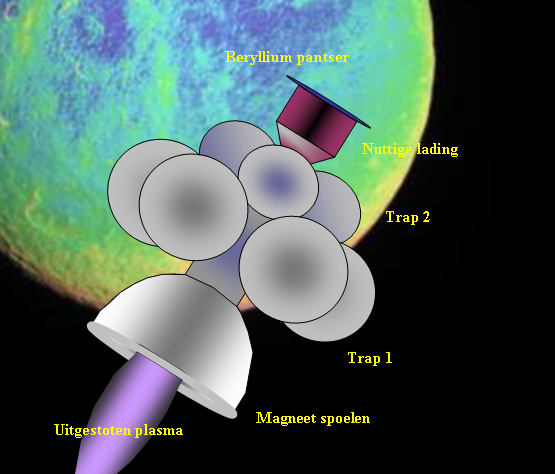
  
     By feeding nuclear pellets into a laser reactor, a plasma explosion could be generated which could slowly accelerate a ship. While there was no plan to slow down Project Daedalus, it would be theoretically capable of reachin other stars. The intended target of the project was the fast-moving Bernard's star (since we know its speed precisely and over the lightyears of travel, all stars would also move due to time) and though the original speeds would be comparatively small, after 50 years of accelerating slowly, it would be moving quite fast.
     One major problem that would be encountered by an astronaut on such a vessel would be acceleration. While it is feasible to build such a ship, the human body can only withstand a certain amount of force and it could get quite tedious to live an entire lifetime feeling several G's of force always pulling on you. A nuclear derived thrust system could be designed to accelerate only at a moderate amount, and though it would take longer for a ship to get to its destination, the astronauts on board would be feeling significantly better about their situation.
     Next week we will look at other options for exploration and the ships that could be used to get there.
May the stars shine bright in your skies!
tip of the hat to the wikipedia spacecraft propulsion page and also to whoever finds flaws in this, I am not the best at nuclear technology

Tuesday, March 29, 2011

A Perspective From Kepler

     First off I am going to make a recommendation. If you like all this cool space stuff and you like seeing a cool new space picture every day make Astronomy Picture of the Day (APOD) one of your bookmarks. Not only does it have a cool new image every day it generally gives a little bit of the history and science behind the picture.
     Today's picture was quite a surprise especially for an aspiring planetary scientist like myself.


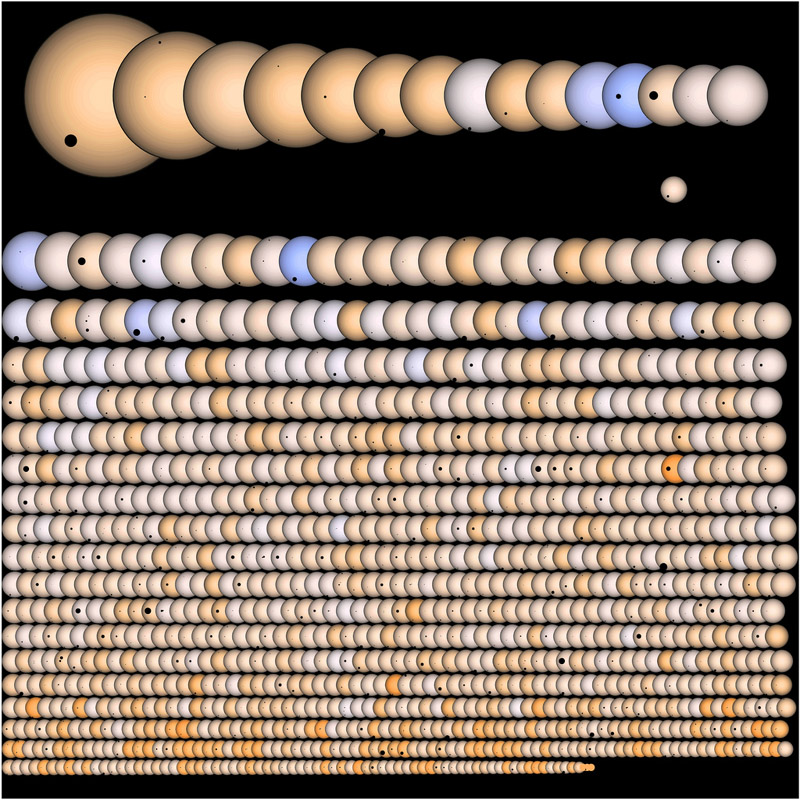
     The above image is a comparison of a number of the stars that Kepler found possible planets around. Each disc is of course a star while the little black dots are the approximate size of the planets found around each star. That smaller disc slightly below the right side of the first row is our sun with the black dot representing Jupiter though if you want to go and see the image on the APOD site, you can see a very small dot representing Earth, its very cool.
     The remarkable insight gained from this picture is the shear number of planets that have been found. these of course are mostly the larger planets, smaller ones may be hiding in their systems and would be too small to detect with our current level of technology. Also remember that this is just a small sample size in comparison to our own galaxy; there are many more stars with planets around them in our grasp. Who knows, one of these little black dots may hold life, its a distinct possibility.
     Even as our own planet loses its uniqueness in the universe, the universe itself, of which we are a distinct part, grows grater and greater with every passing moment.


May the stars shine brightly in your skies!

Tuesday, March 22, 2011

The Universe Is Truly Beautiful

     By far the coolest part about studying the space sciences are the images that come out of our vast array of satellites. The following picture is from the Spitzer Space Telescope and is of the center of our home galaxy in the infrared spectrum.

tip of the hat to NASA on this one
     As humans we are used to perceiving objects in the visible light spectrum. While this is a handy realm of light, visible light has a very hard time passing through the immense dust clouds that dot the galaxy and thus, we have a hard time capturing images of the densest parts of the universe. Thanks to Spitzer, we can image some of these places outside the realm of visible light and thus can see through these unfortunate dust clouds.

Thursday, March 17, 2011

I Have A New Tool!

     So to better improve certain elements of this blog I have obtained a new tool to better attempt to illustrate some of the basic concepts of extra-solar activity along with other fun stuff such as asteroid impacts and satellite paths. There is a wonderful program called Universe Sandbox (which you can download the demo of here). the system acts as a modeling program for gravitational situations such as planetary orbits and collisions.
     A program like this can be extremely useful in illustrating certain concepts such as how a large body on the outside of our solar system would wreck havoc on certain inner system features (its not pretty) or what would happen if you put another Earth on the other side of our orbit (fun stuff, but generally little to no consequence). It also has some fun additions such as seeing how certain rings would act in orbit around Earth. currently I am working on a way of illustrating these models in case the sources I have don't have good images or display the system poorly from the perspective of a amateur to the field.