The universe is a magnificent place full of more that we could ever imagine. As for now though this blog will no longer be covering the news and ideas of the cosmos.
There is a lot to be learned from the world around us especially from space, unfortunately it seems not to be a goal of many of the current governments of the world, the risk is just too much for many and the foresight is lacking.
It is improbable that in the near future the idea of space exploration will advance much beyond where it is currently, still there is hope. There still seems to be a secret lust for space, a support of the planets. When Pluto was stripped of its planethood suddenly it became a meme within the mind of society, maybe the arrival of New Horizons in 2015 will strike a chord within the hearts of the world, but who knows.
We do have the resources in space right now to learn a lot, Kepler still runs, we have satellites heading off to other worlds, and soon the James Webb will be sent up to outshine the fledgling Hubble.
It will take many years of work for science enthusiasts and communicators to bring the wave of information that is approaching to the level of the public, but hopefully when it happens, we will see a new renaissance in the space sciences.
May the stars shine brightly in your skies!

Wednesday, May 4, 2011

Sunday, May 1, 2011
Here's To Reason! (and not economics)
So I was browsing my favorite webcomics this evening when I cam across the newest xkcd.

It is a sad but true reality, the age of human space exploration is slowly dying off. Sure we have people up on the ISS, but what does that fully count for, that not as much exploration as it is experimentation.
For those who have not messed around on xkcd ever, one of the features of the site is rollover text so I will just write it out here: "The universe is probably littered with one-planet graves of cultures which made the sensible economic decision that there's no good reason to go into space -- each discovered, studied, and remembered by the ones who made the irrational decision."
Let that sink in.
I recognize that economic viability is smart to a degree, but what should it matter in the long run, think on a personal level, would you rather exist alone with money or would you rather have slight financial problems but have friends, fun , and constant potential for exploration.
May the stars shine brightly in your skies.
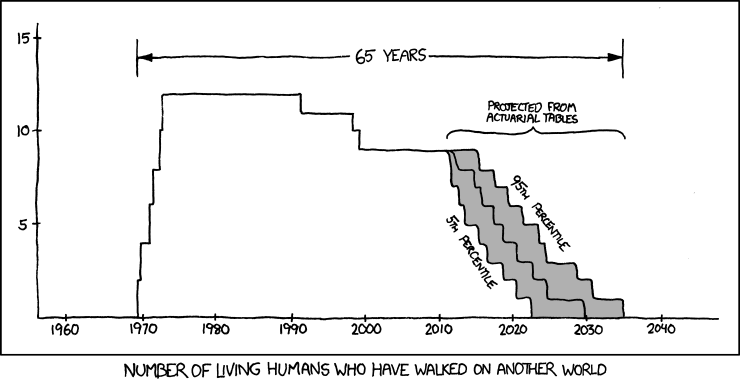
It is a sad but true reality, the age of human space exploration is slowly dying off. Sure we have people up on the ISS, but what does that fully count for, that not as much exploration as it is experimentation.
For those who have not messed around on xkcd ever, one of the features of the site is rollover text so I will just write it out here: "The universe is probably littered with one-planet graves of cultures which made the sensible economic decision that there's no good reason to go into space -- each discovered, studied, and remembered by the ones who made the irrational decision."
Let that sink in.
I recognize that economic viability is smart to a degree, but what should it matter in the long run, think on a personal level, would you rather exist alone with money or would you rather have slight financial problems but have friends, fun , and constant potential for exploration.
May the stars shine brightly in your skies.
Monday, April 25, 2011
A Little Outside The Realm Of Space Science
Being a late night enthusiast not by choice but by my existence as a college student, I tend to catch a lot of fun stuff on late night television (yes I am old school and do watch television). I don't know why I neglected to mention the Late Late Show with Craig Ferguson on the night of February 11 in this blog, but upon being reminded of it by Phil Plait of BadAstronomy, as this is also a science communication blog I have decided to bring it up here.
This interview with Jennifer Ouelette is positive fantastic as she has devoted her life at this point to communicating science on an understandable and interesting level, particularly by framing the perspective to gain interest. What is even more commendable is her position as a non-scientist communicating to other non-scientists. I have read a bit of her book The Calculus Diaries and I am glad that the world can have communicators like her.
It is also important that as scientists and engineers we support and learn from people like Ouelette. To us what we research and pursue is interesting and to be honest, if somebody came up to me and said that they didn't see what was so cool about space, I would have a big problem approaching them.
This interview with Jennifer Ouelette is positive fantastic as she has devoted her life at this point to communicating science on an understandable and interesting level, particularly by framing the perspective to gain interest. What is even more commendable is her position as a non-scientist communicating to other non-scientists. I have read a bit of her book The Calculus Diaries and I am glad that the world can have communicators like her.
It is also important that as scientists and engineers we support and learn from people like Ouelette. To us what we research and pursue is interesting and to be honest, if somebody came up to me and said that they didn't see what was so cool about space, I would have a big problem approaching them.
Saturday, April 23, 2011
Funky Worlds Within Our Own system
It is easy to imagine worlds within our solar system as having at least some similarities to Earth. All planets have a gravitational field and would have some breath-taking vistas. Then there are some differences that are small, every planet with an atmosphere is capable of carrying sound, though each has their own different range due to atmospheric density.
Where the study of planetary sciences gets fun is where the big differences come out, especially on the Pandora's box of weirdness, Saturn. Our ringed planet has already been discovered to have some cool features including continuous auroras and crazy storms.

Now on to features that Saturn has that no other planet has. Due to its spin, Saturn has a hexagonal storm at its North Pole (the answer to why has been solved hopefully) which along with those auroras probably makes for one of the most stunning sights in the whole universe.
Still the planet gets weirder. Recently it was discovered that Saturn has an electron beam link between it and the icy moon of Enceladus. While it is not unheard of for planets to have some link with their moons (in Jupiter it happens all the time), to my knowledge electron beams are pretty much a new thing in the realm of Saturn. So far how they think it happens is the result of ice geysers on the south pole of Enceladus (why these happen is a much deeper mystery in planetary heat flow). When they eject the ice particles into the thin atmosphere, they become electrically charged creating an ionosphere. With the motion on Enceladus plus this ionosphere through the magnetic field of Saturn comes an electromagnetic reaction, which in this case is an electron beam.
Not only is the universe filled with mysteries and elegant solutions, our own Solar System can unveil these as well. I sincerely doubt that this will be the last we hear from the gem of the Solar System.
Where the study of planetary sciences gets fun is where the big differences come out, especially on the Pandora's box of weirdness, Saturn. Our ringed planet has already been discovered to have some cool features including continuous auroras and crazy storms.

 |
| It is truly a beautiful planet. |
Still the planet gets weirder. Recently it was discovered that Saturn has an electron beam link between it and the icy moon of Enceladus. While it is not unheard of for planets to have some link with their moons (in Jupiter it happens all the time), to my knowledge electron beams are pretty much a new thing in the realm of Saturn. So far how they think it happens is the result of ice geysers on the south pole of Enceladus (why these happen is a much deeper mystery in planetary heat flow). When they eject the ice particles into the thin atmosphere, they become electrically charged creating an ionosphere. With the motion on Enceladus plus this ionosphere through the magnetic field of Saturn comes an electromagnetic reaction, which in this case is an electron beam.
Not only is the universe filled with mysteries and elegant solutions, our own Solar System can unveil these as well. I sincerely doubt that this will be the last we hear from the gem of the Solar System.
Wednesday, April 20, 2011
Rocket Wednesday: Spaceships in Films
Other than a lucky few who actually have seen a spacecraft in person, the only outlet that people get to experience a spacecraft close up is in the movies. From the terrifying Star Destroyers of the Star Wars universe to the sleek agile Federation ships of Star Trek there are quite a variety of ships presented within movies.
The ships presented in this jocund analysis are "feasible" in that they are based around a real propulsion method so here we go.
 |
| so many ships to choose from, so little time |
(rest after the break)
Friday, April 15, 2011
Astronomy Fact of the Week: The Beginning of Human Spaceflight.
This past week was dominated by space history. It was 50 years ago last Tuesday that Yuri Gagarin became the first man to reach Earth orbit. 30 years ago on that same day, Columbia became the first Space Shuttle to leave the atmosphere, and 41 years ago on Thursday, a oxygen tank failure nearly left Apollo 13 lost to the stars. While these three events were powerful, each had its own ramifications. Gagarin died young in a jet crash, Columbia became one of the tragedies of the United States space program, and, though it made it back safely, Apollo 13 called to question some of the equipment and techniques of the day.
Space is dangerous, and not just on a large sense, but even very locally. When humans first escape out to the stars, they do not need to worry about supernovae or black holes just yet. There are much more immediate concerns, such as cosmic radiation, solar flares, and micrometeorite impacts. The smallest overlooked variable may be the downfall of countless years of research and development. So why would humans want to go to space? Where is the reward for all of the risk and work? For each individual this may be different, but perhaps as Carl Sagan said, “Exploration is in our nature; we began as wanderers and we are wanderers still.”
Space holds a vast array of discoveries, wonders, and resources, and while Earth has these as well, some day it will run out. If the human species is around at that time, it will be of utmost necessity that we strike out for the cosmos. Why wait for the fateful day when the Earth can no longer provide? Our planet is beautiful, and would it not be better to preserve its beauty than to rob it of everything before moving on?
Along with crucial elements for our survival, space may hold something else, life. It is highly unlikely that we are alone in the universe, and the benefit that could come from a sharing of knowledge between two different forms of life that have two entirely different histories could be astounding. That knowledge may be just what is needed for humans to make it to the end of everything, to those last moments of the universe.
May the stars shine brightly in your skies.
Space is dangerous, and not just on a large sense, but even very locally. When humans first escape out to the stars, they do not need to worry about supernovae or black holes just yet. There are much more immediate concerns, such as cosmic radiation, solar flares, and micrometeorite impacts. The smallest overlooked variable may be the downfall of countless years of research and development. So why would humans want to go to space? Where is the reward for all of the risk and work? For each individual this may be different, but perhaps as Carl Sagan said, “Exploration is in our nature; we began as wanderers and we are wanderers still.”
Space holds a vast array of discoveries, wonders, and resources, and while Earth has these as well, some day it will run out. If the human species is around at that time, it will be of utmost necessity that we strike out for the cosmos. Why wait for the fateful day when the Earth can no longer provide? Our planet is beautiful, and would it not be better to preserve its beauty than to rob it of everything before moving on?
Along with crucial elements for our survival, space may hold something else, life. It is highly unlikely that we are alone in the universe, and the benefit that could come from a sharing of knowledge between two different forms of life that have two entirely different histories could be astounding. That knowledge may be just what is needed for humans to make it to the end of everything, to those last moments of the universe.
May the stars shine brightly in your skies.
Tuesday, April 12, 2011
Sizing Up The Universe
One element of space exploration that still amazes me is the relative positions of all of the stars. From here on Earth it is relatively hard to determine the depth of space, but through a bit of simulation magic, we can see that it is hardly a sheet with holes poked in it as the Greeks once thought.
Part I in which it was a cloudy night and I couldn't do much.
Part II in which I went to my computer and made magic happen.
May the stars shine brightly in your skies.
Thursday, April 7, 2011
Just A Few Awesome Minutes of Your Time
So I found this video while surfing the web today, unfortunately it is not a youtube video so you will have to follow this link. It is fully worth your time.

May the stars shine brightly in your skies!

May the stars shine brightly in your skies!
Wednesday, April 6, 2011
Rocket Wednesday: Rockets Of The (Close) Future
This week has proven very timely for rocket Wednesday with the announcement of the new rocket from Space X. While the era of Saturn Vs and N1s was awesome and produced some of the most powerful machinery ever conceived, these day the race to space is being dominated by companies rather than governments.
Of particular interest is the company Space X, so far in their history they have successfully tested several rockets including the Falcon 1 and Falcon 9 which may go into use fairly soon. they have also developed capsules that can carry human beings. Still up until recently the heavy lifting class of rockets was untouched by corporate entities.
That is until now, meet the Falcon Heavy
The Falcon Heavy is a revolutionary rocket that significantly out-classes every modern rocket. It is capable of lifting 53 metric tons (or half of a blue whale according to wolfram alpha) and is remarkably cheaper than any other option. With the Falcon Heavy you can put objects up at a price of only $1000/pound which is, for comparison, 1/10th of the price for lift on the Space Shuttle.
It is a chemical based rocket that functions a bit like the space shuttle during launch. It will launch with the full body and will then eject the two side pods at a certain altitude leaving only the central rocket to keep going. An animation can be seen at their site (along with videos of some of their other launches).
Rockets like the Falcon Heavy will serve an important role as the key beginning rockets for the next generation of private space ventures.
May the stars shine brightly in your skies!
Of particular interest is the company Space X, so far in their history they have successfully tested several rockets including the Falcon 1 and Falcon 9 which may go into use fairly soon. they have also developed capsules that can carry human beings. Still up until recently the heavy lifting class of rockets was untouched by corporate entities.
That is until now, meet the Falcon Heavy
 |
| tip of the hat to Bad Astronomy |
It is a chemical based rocket that functions a bit like the space shuttle during launch. It will launch with the full body and will then eject the two side pods at a certain altitude leaving only the central rocket to keep going. An animation can be seen at their site (along with videos of some of their other launches).
Rockets like the Falcon Heavy will serve an important role as the key beginning rockets for the next generation of private space ventures.
May the stars shine brightly in your skies!
Wednesday, March 30, 2011
Rocket Wednesday
In a curse of irony, last time I had a rocket Wednesday I mentioned that I would cover nuclear powered rockets and at the time of this writing, the future nuclear landscape has changed drastically due to the events in Japan (which I covered in an earlier post). Still as an important possibility in propelling starships, nuclear still is an important option to consider and is worth looking in to.
While there are many different varieties of nuclear propulsion available to starships, one of the more fascinating is nuclear pulse propulsion. The concept of driving a ship with nuclear based technology is not new and dates back into the WWII era, but by far one of the more interesting ideas came out of the 70's. Project Daedalus was a British plan to build the first interstellar ship with the intent of reaching the stars within a life time.

By feeding nuclear pellets into a laser reactor, a plasma explosion could be generated which could slowly accelerate a ship. While there was no plan to slow down Project Daedalus, it would be theoretically capable of reachin other stars. The intended target of the project was the fast-moving Bernard's star (since we know its speed precisely and over the lightyears of travel, all stars would also move due to time) and though the original speeds would be comparatively small, after 50 years of accelerating slowly, it would be moving quite fast.
One major problem that would be encountered by an astronaut on such a vessel would be acceleration. While it is feasible to build such a ship, the human body can only withstand a certain amount of force and it could get quite tedious to live an entire lifetime feeling several G's of force always pulling on you. A nuclear derived thrust system could be designed to accelerate only at a moderate amount, and though it would take longer for a ship to get to its destination, the astronauts on board would be feeling significantly better about their situation.
Next week we will look at other options for exploration and the ships that could be used to get there.
May the stars shine bright in your skies!
tip of the hat to the wikipedia spacecraft propulsion page and also to whoever finds flaws in this, I am not the best at nuclear technology
While there are many different varieties of nuclear propulsion available to starships, one of the more fascinating is nuclear pulse propulsion. The concept of driving a ship with nuclear based technology is not new and dates back into the WWII era, but by far one of the more interesting ideas came out of the 70's. Project Daedalus was a British plan to build the first interstellar ship with the intent of reaching the stars within a life time.
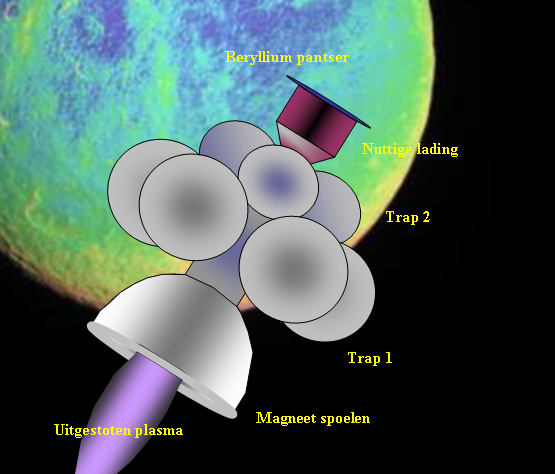
By feeding nuclear pellets into a laser reactor, a plasma explosion could be generated which could slowly accelerate a ship. While there was no plan to slow down Project Daedalus, it would be theoretically capable of reachin other stars. The intended target of the project was the fast-moving Bernard's star (since we know its speed precisely and over the lightyears of travel, all stars would also move due to time) and though the original speeds would be comparatively small, after 50 years of accelerating slowly, it would be moving quite fast.
One major problem that would be encountered by an astronaut on such a vessel would be acceleration. While it is feasible to build such a ship, the human body can only withstand a certain amount of force and it could get quite tedious to live an entire lifetime feeling several G's of force always pulling on you. A nuclear derived thrust system could be designed to accelerate only at a moderate amount, and though it would take longer for a ship to get to its destination, the astronauts on board would be feeling significantly better about their situation.
Next week we will look at other options for exploration and the ships that could be used to get there.
May the stars shine bright in your skies!
tip of the hat to the wikipedia spacecraft propulsion page and also to whoever finds flaws in this, I am not the best at nuclear technology
Tuesday, March 29, 2011
A Perspective From Kepler
First off I am going to make a recommendation. If you like all this cool space stuff and you like seeing a cool new space picture every day make Astronomy Picture of the Day (APOD) one of your bookmarks. Not only does it have a cool new image every day it generally gives a little bit of the history and science behind the picture.
Today's picture was quite a surprise especially for an aspiring planetary scientist like myself.

The above image is a comparison of a number of the stars that Kepler found possible planets around. Each disc is of course a star while the little black dots are the approximate size of the planets found around each star. That smaller disc slightly below the right side of the first row is our sun with the black dot representing Jupiter though if you want to go and see the image on the APOD site, you can see a very small dot representing Earth, its very cool.
The remarkable insight gained from this picture is the shear number of planets that have been found. these of course are mostly the larger planets, smaller ones may be hiding in their systems and would be too small to detect with our current level of technology. Also remember that this is just a small sample size in comparison to our own galaxy; there are many more stars with planets around them in our grasp. Who knows, one of these little black dots may hold life, its a distinct possibility.
Even as our own planet loses its uniqueness in the universe, the universe itself, of which we are a distinct part, grows grater and greater with every passing moment.
May the stars shine brightly in your skies!
Today's picture was quite a surprise especially for an aspiring planetary scientist like myself.
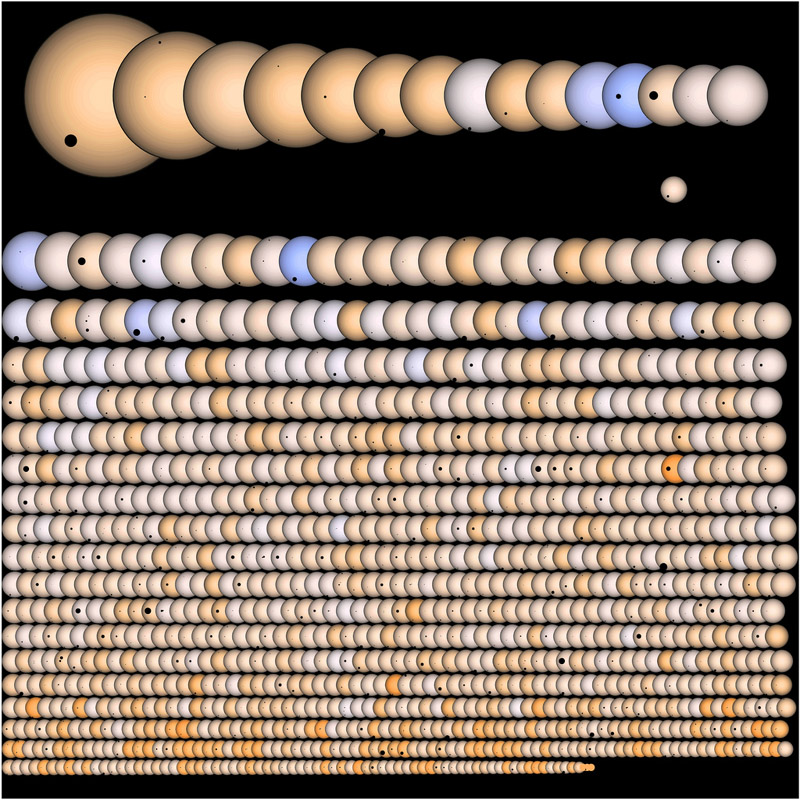
The above image is a comparison of a number of the stars that Kepler found possible planets around. Each disc is of course a star while the little black dots are the approximate size of the planets found around each star. That smaller disc slightly below the right side of the first row is our sun with the black dot representing Jupiter though if you want to go and see the image on the APOD site, you can see a very small dot representing Earth, its very cool.
The remarkable insight gained from this picture is the shear number of planets that have been found. these of course are mostly the larger planets, smaller ones may be hiding in their systems and would be too small to detect with our current level of technology. Also remember that this is just a small sample size in comparison to our own galaxy; there are many more stars with planets around them in our grasp. Who knows, one of these little black dots may hold life, its a distinct possibility.
Even as our own planet loses its uniqueness in the universe, the universe itself, of which we are a distinct part, grows grater and greater with every passing moment.
May the stars shine brightly in your skies!
Tuesday, March 22, 2011
The Universe Is Truly Beautiful
By far the coolest part about studying the space sciences are the images that come out of our vast array of satellites. The following picture is from the Spitzer Space Telescope and is of the center of our home galaxy in the infrared spectrum.
 |
| tip of the hat to NASA on this one |
Thursday, March 17, 2011
I Have A New Tool!
So to better improve certain elements of this blog I have obtained a new tool to better attempt to illustrate some of the basic concepts of extra-solar activity along with other fun stuff such as asteroid impacts and satellite paths. There is a wonderful program called Universe Sandbox (which you can download the demo of here). the system acts as a modeling program for gravitational situations such as planetary orbits and collisions.
A program like this can be extremely useful in illustrating certain concepts such as how a large body on the outside of our solar system would wreck havoc on certain inner system features (its not pretty) or what would happen if you put another Earth on the other side of our orbit (fun stuff, but generally little to no consequence). It also has some fun additions such as seeing how certain rings would act in orbit around Earth. currently I am working on a way of illustrating these models in case the sources I have don't have good images or display the system poorly from the perspective of a amateur to the field.
A program like this can be extremely useful in illustrating certain concepts such as how a large body on the outside of our solar system would wreck havoc on certain inner system features (its not pretty) or what would happen if you put another Earth on the other side of our orbit (fun stuff, but generally little to no consequence). It also has some fun additions such as seeing how certain rings would act in orbit around Earth. currently I am working on a way of illustrating these models in case the sources I have don't have good images or display the system poorly from the perspective of a amateur to the field.
Saturday, March 12, 2011
Hyping Up The Science
Following the recent earthquake and resulting tsunami and then resulting nuclear emergency in Japan these last few days I have noticed quite a bit about how different organizations portray the state of crisis in an emergency. To set the tone of this post, I began watching the BBC live feed about one hour after the earthquake hit, though I was aware of it slightly after the tsunami hit.
For the most part the BBC did not get very sensationalist about the disaster, and while they sure did love showing the footage of the tsunami rushing over the farmland, so did every other news network. What shocked me was the downplay of the deathtoll. Unlike other networks the BBC clearly stated how many were known to be dead and specifically separated that from the amount missing. Also shocking for me personally as an American viewer was the presence of a science correspondent who directly interacted with the anchor of the news program and informed of the science and geology behind the quake; they were unafraid to wake up a geophysicist here and there and did not restrict their sources to UK based organizations.
While I did not observe much in the way of CNN, Fox, or MSNBC, I did also keep up with the Al Jazeera feed which was reliable as it moves into the realm of globally respected news networks. From my understanding the American networks did not have as much of the science adequately portrayed and focused more on the shock and the disaster at hand while more estimating a death toll, it was only after a few hours in that the BBC began to ask for estimated deaths and as of 1:07 PM on the 12th, they still have yet to estimate an economic loss.
The best example of hype has focused more around the Fukushima nuclear facility. It is known that the cooling system failed and the Japanese government was forced to vent gas from the facility to prevent a meltdown. Beyond that different sources put it in varying lights. I personally was woken up this morning to be told that the entire facility had exploded including the containment, though I am unsure of where my personal source had got their fears. I quickly jumped on the web and was regaled with articles stating one of the reactors had experienced meltdown, that Japan was at a true risk of a Chernobyl style disaster, or as it really is, a building had exploded, but mostly everything would turn up alright, less than a Three-Mile Island.
At this point I am still seeing these sensationalist phrases such as "Japanese Nuclear Reactor Explodes" which have half-truths in them and are baiting everybody. I watched a basic social media post turn into an all out verbal brawl over nuclear power's safety with the person against power citing articles at this point have been deem to solely be sensationalist without a fact around. Even my grand scientific network of BBC has been running sensational claims in the ticker, though the main stories are generally reliable.
My personal fear about these sensational claims is though they do attract the world to this remarkable disaster, they also polarize people before they can make their decisions themselves. This disaster has happened at an interesting time in the energy community. Nuclear power has begun to regain stride as a possible alternative and it would be unfortunate to see it quelled again. We must remember this plant is mostly under control, it is better than Three-Mile was and not to mention it was an 8.9 earthquake followed immediately by a tsunami. The other plants in the network have been fine, they worked as they were meant to and they still have a strong future ahead of them. Lets not chicken out now.
For the most part the BBC did not get very sensationalist about the disaster, and while they sure did love showing the footage of the tsunami rushing over the farmland, so did every other news network. What shocked me was the downplay of the deathtoll. Unlike other networks the BBC clearly stated how many were known to be dead and specifically separated that from the amount missing. Also shocking for me personally as an American viewer was the presence of a science correspondent who directly interacted with the anchor of the news program and informed of the science and geology behind the quake; they were unafraid to wake up a geophysicist here and there and did not restrict their sources to UK based organizations.
While I did not observe much in the way of CNN, Fox, or MSNBC, I did also keep up with the Al Jazeera feed which was reliable as it moves into the realm of globally respected news networks. From my understanding the American networks did not have as much of the science adequately portrayed and focused more on the shock and the disaster at hand while more estimating a death toll, it was only after a few hours in that the BBC began to ask for estimated deaths and as of 1:07 PM on the 12th, they still have yet to estimate an economic loss.
The best example of hype has focused more around the Fukushima nuclear facility. It is known that the cooling system failed and the Japanese government was forced to vent gas from the facility to prevent a meltdown. Beyond that different sources put it in varying lights. I personally was woken up this morning to be told that the entire facility had exploded including the containment, though I am unsure of where my personal source had got their fears. I quickly jumped on the web and was regaled with articles stating one of the reactors had experienced meltdown, that Japan was at a true risk of a Chernobyl style disaster, or as it really is, a building had exploded, but mostly everything would turn up alright, less than a Three-Mile Island.
At this point I am still seeing these sensationalist phrases such as "Japanese Nuclear Reactor Explodes" which have half-truths in them and are baiting everybody. I watched a basic social media post turn into an all out verbal brawl over nuclear power's safety with the person against power citing articles at this point have been deem to solely be sensationalist without a fact around. Even my grand scientific network of BBC has been running sensational claims in the ticker, though the main stories are generally reliable.
My personal fear about these sensational claims is though they do attract the world to this remarkable disaster, they also polarize people before they can make their decisions themselves. This disaster has happened at an interesting time in the energy community. Nuclear power has begun to regain stride as a possible alternative and it would be unfortunate to see it quelled again. We must remember this plant is mostly under control, it is better than Three-Mile was and not to mention it was an 8.9 earthquake followed immediately by a tsunami. The other plants in the network have been fine, they worked as they were meant to and they still have a strong future ahead of them. Lets not chicken out now.
Wednesday, March 9, 2011
Rocket Wednesday
Though today is the final landing of Space Shuttle Discovery, I will not be focusing on it other than saying that it landed safely and cutting off the program here is halting an expensive but extremely useful asset in space research.
No, what I am going to discuss is propulsion methods, or more precisely, Solar Sails. There are a variety of different propulsion methods in space from the currently used chemical propellants, to the more futuristic electrical, to the somewhat controversial nuclear option, and a variety of strange methods including the innovative solar sails.
Contrary to what logic would dictate, space has wind, its just not exactly as it is here on Earth. When you are around a star, there is generally a very strong supply of photons heading out from the star (and by generally I mean always.) We observe this stream as light, but strangely enough though these particles theoretically have no mass, they hold a momentum and if they run up against an object, they can impart that momentum into the object. With enough photons bombarding a surface, especially if it is made to catch that momentum, and object should be able to theoretically move in space and gain up momentum, kinda like a sail on a sailing vessel would catch the winds momentum (physicists I know this isn't exactly true, it just works out).
The sail will of course be attached to a satellite or a ship and will be retracted when the ship moves out of the path of the photon movement, thus it keeps up the momentum. The pros of the propulsion method is that it requires no fuel and it can work over a fairly extensive range. The cons on the other hand are that it only works going outwards, for now at least, and that it is extremely delicate. Recently the first one was tried out and their main concern was that it wouldn't unfurl without tearing. Luckily it worked out.
May the stars shine brightly in your skies and check back next week for the nuclear option!
No, what I am going to discuss is propulsion methods, or more precisely, Solar Sails. There are a variety of different propulsion methods in space from the currently used chemical propellants, to the more futuristic electrical, to the somewhat controversial nuclear option, and a variety of strange methods including the innovative solar sails.
 |
| We have come full circle in a way |
Contrary to what logic would dictate, space has wind, its just not exactly as it is here on Earth. When you are around a star, there is generally a very strong supply of photons heading out from the star (and by generally I mean always.) We observe this stream as light, but strangely enough though these particles theoretically have no mass, they hold a momentum and if they run up against an object, they can impart that momentum into the object. With enough photons bombarding a surface, especially if it is made to catch that momentum, and object should be able to theoretically move in space and gain up momentum, kinda like a sail on a sailing vessel would catch the winds momentum (physicists I know this isn't exactly true, it just works out).
The sail will of course be attached to a satellite or a ship and will be retracted when the ship moves out of the path of the photon movement, thus it keeps up the momentum. The pros of the propulsion method is that it requires no fuel and it can work over a fairly extensive range. The cons on the other hand are that it only works going outwards, for now at least, and that it is extremely delicate. Recently the first one was tried out and their main concern was that it wouldn't unfurl without tearing. Luckily it worked out.
May the stars shine brightly in your skies and check back next week for the nuclear option!
Tuesday, March 8, 2011
Is There Life Out There Or Are We Just The Stars Of A Lonely Party
First off I would like to apologize for a lack of updates recently, some personal issues came up and I have had a hard time keeping a regular schedule.
Nonetheless I had to poke my head up when the blogosphere erupted over news from the Journal of Cosmology. According to the Journal, Dr. Richard Hoover of NASA has stated that there is a chance that a meteorite that he was looking at has fossilized alien life. Pretty cool eh?
Still, there are problems with this and I will lay them down:
Nonetheless I had to poke my head up when the blogosphere erupted over news from the Journal of Cosmology. According to the Journal, Dr. Richard Hoover of NASA has stated that there is a chance that a meteorite that he was looking at has fossilized alien life. Pretty cool eh?
 |
| Hello there neighbor? |
- There is always risk of contamination, according to the article it is not a solid chunk of meteor, its fractured, and on top of that it didn't fall in some desolate wasteland, like Antarctica, where there is little in the way of life to crawl in, it fell in Africa, which is teeming with life.
- There is a chance that it isn't even life at all, there is much in the universe that looks like life but really isn't. I have looked at rocks which look like it has tracks, but these were just results of wind or tides. While these have a high carbon content which is promising, carbon is not solely unique to the kingdom of life.
- SPACE IS BIG and life is small. If you took a sample of Earth right now, yes it would likely have something like a piece of pollen, but go back a couple hundred million years, which is the maximum extent that life in our Solar system has got if it were to exist, and your probability of finding something drops down to around zero.
- Its happened before. We are constantly looking for life and getting duped. See 3 for why
It would be cool though eh?
May the stars shine brightly in your skies.
Wednesday, March 2, 2011
Astro Fact: The Truth About Shooting Stars
Once upon a time a wise animated cricket said something to do about dreams coming true and shooting stars, or maybe those were just immobile stars, oh well. Still when a shooting star passes overhead there is a mix of awe and fascination which is shocking for an event that lasts less than a second.
If I were to ask how large a shooting star is, I image from experience that the range of size would be between the size of a small washing machine and a decent car; the truth on the other hand is significantly more brilliant given the effect. for the most part a normal shooting star is between the size of a letter in this article to at most the size of a golf ball. Shocking then is it that such a small object can give off such a large amount of light? Not really...
When an object begins to fall into the atmosphere, it begins rubbing against atmospheric particles and while there aren't many atmospheric particles, the objects are moving very fast. Incredibly fast! That speed equals friction and that friction brings about heat and that heat messes with the external skin of the falling rock and that in turn emits a whole lot of light, for a second at least.
For the most part these dust bits fall to Earth like snow but every once in a while one will fall down and impact, or at least get close to impacting. For the most part these rocks are fairly loose and they explode before they hit the ground, hence blast craters. Occasionally one will be harder and thus we get meteorites which can unveil the history of the solar system.
Sometimes they also just pass through, say hello and go on their merry way, like the famous Grand Tetons Meteor of 1972.
May the stars shine brightly in your skies!
If I were to ask how large a shooting star is, I image from experience that the range of size would be between the size of a small washing machine and a decent car; the truth on the other hand is significantly more brilliant given the effect. for the most part a normal shooting star is between the size of a letter in this article to at most the size of a golf ball. Shocking then is it that such a small object can give off such a large amount of light? Not really...
When an object begins to fall into the atmosphere, it begins rubbing against atmospheric particles and while there aren't many atmospheric particles, the objects are moving very fast. Incredibly fast! That speed equals friction and that friction brings about heat and that heat messes with the external skin of the falling rock and that in turn emits a whole lot of light, for a second at least.
For the most part these dust bits fall to Earth like snow but every once in a while one will fall down and impact, or at least get close to impacting. For the most part these rocks are fairly loose and they explode before they hit the ground, hence blast craters. Occasionally one will be harder and thus we get meteorites which can unveil the history of the solar system.
Sometimes they also just pass through, say hello and go on their merry way, like the famous Grand Tetons Meteor of 1972.
May the stars shine brightly in your skies!
The One Where I Start Talking About Rockets
Scientists can hypothesize as much as they want about what planets may lay outside our home, we can dream of lush worlds like Pandora from Avatar, desert wastelands like Tatooine from Star Wars, or intellectual paradises like Gallifrey from Dr. Who; none of it really matters much though if we have no means of making it to those places. While the news media is filled with talk of nearly Earth-sized planets being found, very few reports focus on the future of rocketry and space transport.
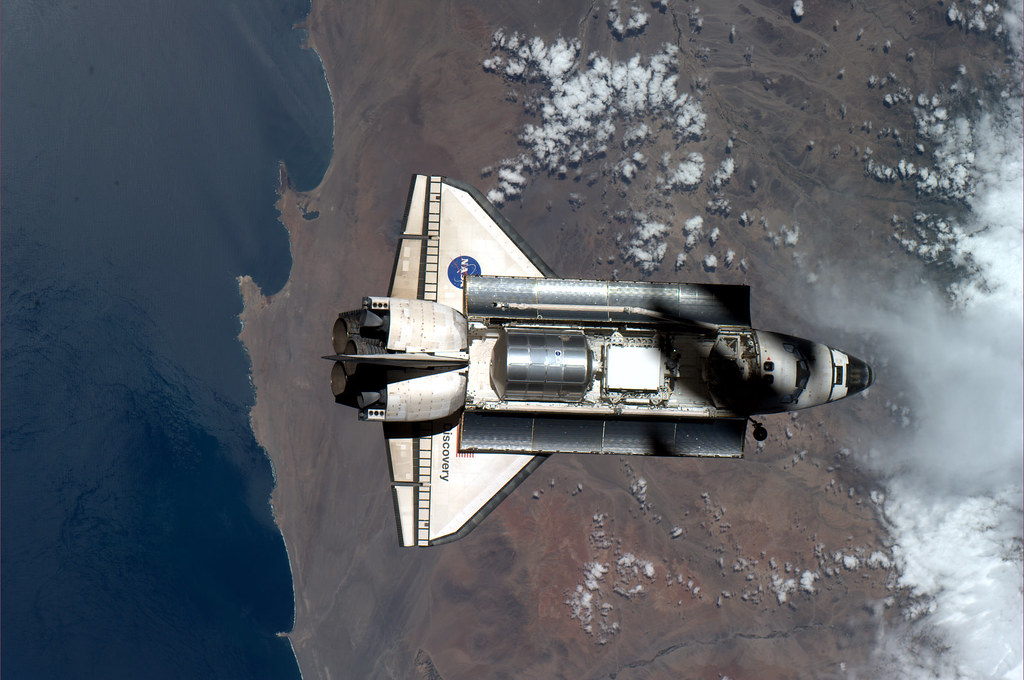
Don't get me wrong, we have made some huge strides in how we get from the surface world up to space, the Saturn V rocket was a spectacular feat of human engineering. Still these can get us to the Moon, our nearest neighbor with a small price tag of 40 or so billion dollars for development and launch, 50-80 if you include everything to do with the program. Currently our main workhorse for human transport is the Space Shuttle, which as of writing, is nearly done with. While the Space Shuttle is advanced, its the equivalent of a shallow water barge when compared to the technology required for deep space travel.
 |
| pretty, yes, meant to handle the tortures of deep space, not at all |
On the other hand we have a vast array of launch vehicles not compatible with human flight. While most of these push small satellites up to the edge of space, a few of them have delivered payloads that are well outside the bounds of the traditional solar system. These, while fast, are impractical for humans, they are too small and they accelerate fast enough to turn your average astronaut into a splatter. So we need something that is reliable, like a Space Shuttle or Saturn V, or dare I say it, Buran Shuttle, but also meant for deep space, like one of Lockheed's army of rockets.
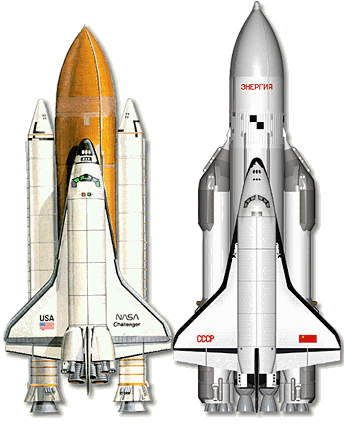 |
| yes, the Russians had a shuttle, and admittedly, it was significantly cooler than ours |
There have been many designs proposed, such as attachments to the now cancelled Constellation program, but none have come to an actual building phase, which is unfortunate.
So now comes my opinion; I feel we need space docks, we will never be able to make a ship that can truly efficiently and safely cross the vast distances (and times, see last astro fact) here on Earth, it will just waste too much material to leave the planet and theres a large risk at that point, especially with the cost and complexity of a ship like that. So we make a port in space where we can build ships from materials sent up from the Earth (or the moon, it costs less fuel) and we have no risk of a problem on launch, we use cheaper rockets to transport, and then when we take off, we send the astronauts up and board them in space, sure there is now crowning launch moment like what defined the Apollo program, but it is a significantly smaller risk.
To keep people coming back, I will add a cliff hanger. Next time around on Rocket Wednesday I will discuss some rocket types that we could use efficiently in space and some of the problems associated with human space travel. See you back here then.
May the stars shine brightly in your skies!
Monday, February 28, 2011
Astro Fact: Cosmic Time
From the reference point of a human being here on Earth, space and time are pretty much independent of each other, when a world class runner competes they don't have any adjustments to make for the percentage of the speed of light the runner is going, nor any amount of gravitational anomaly or possible black holes interfering with data. In space, this is not the case as much.
Within the realms of deep space, almost everything that we care about moves fast and that can cause some problems with timing. For instance light moves incredibly fast, by the time you have read this light could have made it to the moon and back a few times. While the moon is not all that far away at around 384400 km, when we send satellites out to the edges of the solar system (such as the Voyager probes and New Horizons) there can be significant signal delay as the message rushes its way out at the speed of light.
In even deeper space when we see the stars we are actually looking into the past. For stars nearby this is not much of a problem, the Centauri system is only around 4.3 lightyears away, not all that far when compared to the millions of light years to other galaxies or the billions of light years out to the edge of the ever expanding universe. Still, these vast amounts of time and distance can cause problems especially when it comes to knowing exactly where and when and object is. Some day if we are to venture out beyond the reaches of our home system, communicating home will be very difficult unless we can break physics, which is unlikely.
Even more bizarre is the idea that not only are deep space objects truly in a different location due to time, but our perspective of where they were at that time may be off due to gravity. Everybody has heard from a young age that black holes can bring in light, but what about the light that doesn't fall in? It turns out that this light can bend around a black hole (in fact it doesn't necessarily have to be a black hole, it can be just about any massive and heavy object such as a galactic cluster). When observed here on Earth, astronomers see this effect as a lensing of background objects.

Each of those thin bent streams of light is actually a normal shaped galaxy somewhere behind the massive cluster in the foreground.
So when it comes to space, you cannot simply ask "how far away is it" you must also remember that what we are seeing is a dynamic view of the past.
May the stars shine brightly in your skies.
 |
| This guy may have some problems with relativity though. |
In even deeper space when we see the stars we are actually looking into the past. For stars nearby this is not much of a problem, the Centauri system is only around 4.3 lightyears away, not all that far when compared to the millions of light years to other galaxies or the billions of light years out to the edge of the ever expanding universe. Still, these vast amounts of time and distance can cause problems especially when it comes to knowing exactly where and when and object is. Some day if we are to venture out beyond the reaches of our home system, communicating home will be very difficult unless we can break physics, which is unlikely.
Even more bizarre is the idea that not only are deep space objects truly in a different location due to time, but our perspective of where they were at that time may be off due to gravity. Everybody has heard from a young age that black holes can bring in light, but what about the light that doesn't fall in? It turns out that this light can bend around a black hole (in fact it doesn't necessarily have to be a black hole, it can be just about any massive and heavy object such as a galactic cluster). When observed here on Earth, astronomers see this effect as a lensing of background objects.

Each of those thin bent streams of light is actually a normal shaped galaxy somewhere behind the massive cluster in the foreground.
So when it comes to space, you cannot simply ask "how far away is it" you must also remember that what we are seeing is a dynamic view of the past.
May the stars shine brightly in your skies.
A Baby In The Cosmic Basket
When it comes to human experience in the cosmos, we have begun to accumulate a wide base of knowledge and as of a few weeks ago we have another important concept down. At long last we believe we have seen a new planet in the process of formation. While he have seen the destruction of stars, detected the effects of black holes, and "heard" the resonance of the big bang, we still not yet seen a planet forming, at least until now.
The baby planet in question is around the star T Chamaeleontis (T Cha) and while it has not been precisely seen, there is evidence that a new planet is forming around the star. Usually when astronomers find a young star, they also find a basic cloud of dust circling the star. The difference between this star and all the rest is that astronomers have found two rings instead of one and it is a distinct possibility that this gap represents a planet.
On the other hand there is the possibility that it is an elusive brown dwarf which would also clear up a band around a star.
The true excitement through all of this is that we can actually detect these things; how far we have come in these past few decades in terms of what we can see is stellar at least (pardon the pun), those recent followers of my blog may remember the excitement over the Kepler results and the shear volume of data that brought back. Space is full of discoveries that we can make if we just focus the technology and realize that some discoveries are worth the time, effort, and tax dollars.
May The Stars Shine Brightly In Your Skies
tip of the hat to Science Daily
 |
| Artists Interpretation of a new planet around the young star T Cha |
On the other hand there is the possibility that it is an elusive brown dwarf which would also clear up a band around a star.
The true excitement through all of this is that we can actually detect these things; how far we have come in these past few decades in terms of what we can see is stellar at least (pardon the pun), those recent followers of my blog may remember the excitement over the Kepler results and the shear volume of data that brought back. Space is full of discoveries that we can make if we just focus the technology and realize that some discoveries are worth the time, effort, and tax dollars.
May The Stars Shine Brightly In Your Skies
tip of the hat to Science Daily
Subscribe to:
Posts (Atom)